 The First Encyclopedia Your First Knowledge Home
The dissolution of the Soviet Union
Learn about the history of The dissolution of the Soviet Union which put an end to the Cold War
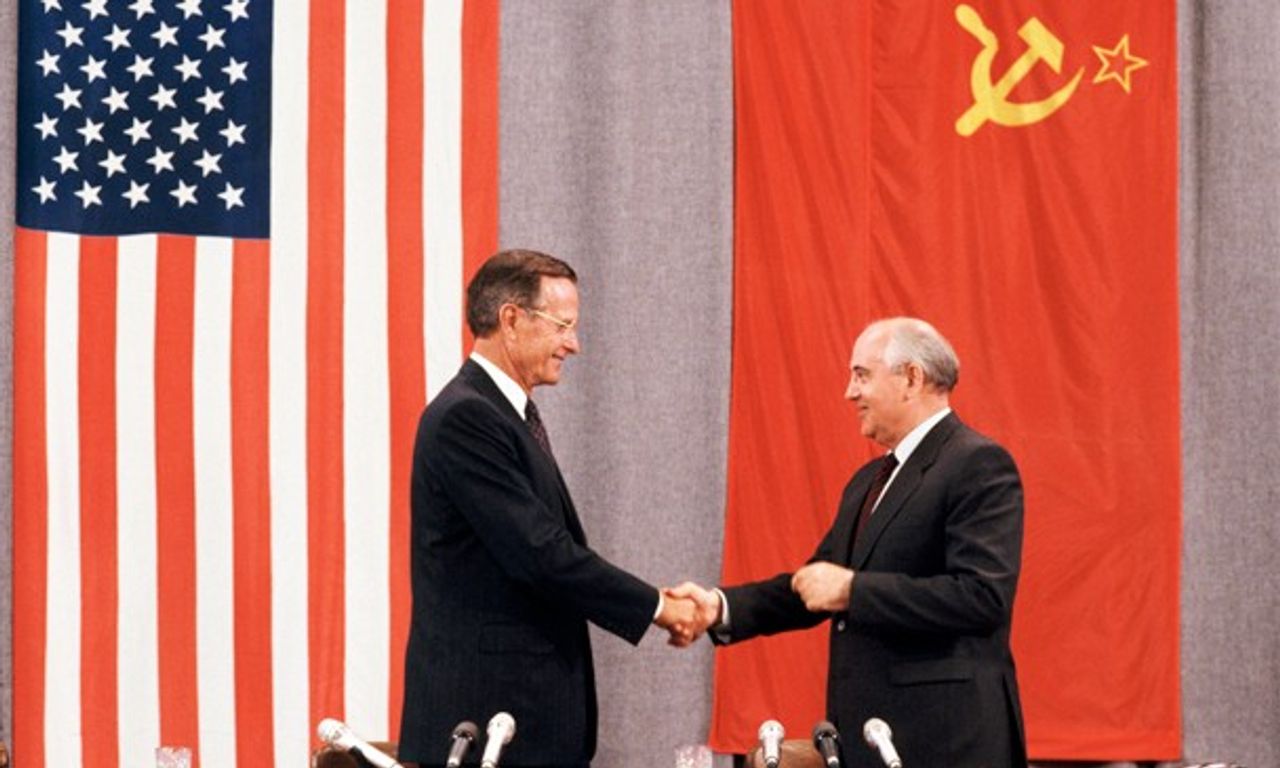
The dissolution of the Soviet Union
When was the Soviet Union dissolved?
The Soviet Union began to fall apart in the late 1980s, and it finally did so on December 25, 1991, when it was divided up into 15 sovereign states. The Cold War between the Soviet Union and the United States came to an end as a result of this.
Mikhail Gorbachev Becomes General Secretary
In 1985, Mikhail Gorbachev was chosen as the Soviet Union’s general secretary. The Soviet Union’s economy was in poor health when he gained power, and his plan was to modernize both the political system and the economy.
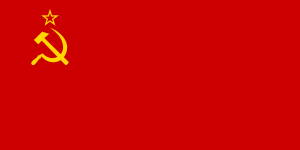 Flag of the Soviet Union
Glasnost perestroika reforms
The two major pillars of Gorbachev’s reform were. He dubbed the first Glasnost. More speech and openness in governance were made possible by the Glasnost movement. Government representatives would be answerable to the public for their activities. Glasnost was beneficial to the populace, but it also gave rise to the first protests and media coverage of the problems. Many of the outlying states used this new found freedom to declare their desire for independence.
The other significant change was known as Perestroika. Restructuring was what perestroika meant. Gorbachev wanted to improve the efficiency of the Soviet economy. He relaxed some of the strict controls the government maintained over the economy and let limited private ownership. The Soviet Union’s populace and economy, however, were accustomed to the government handling everything. Before things improved, they became worse.
Baltic Region
As a result of Gorbachev’s reforms, certain peripheral Soviet states started to rebel. The Baltic states of Estonia, Lithuania, and Latvia were the first to demand their freedom.
Nationalist Movement Spreads
Soon, more nations, like Armenia, Moldova, Ukraine, and Georgia, yearned for independence. The pressure of so many nations desiring independence started to be felt by the Soviet Union’s central leadership.
Attempted Takeover of the Government
Soviet hardliners chose to intervene when the communist regime was about to fall. They seized Gorbachev in August 1991 and declared him incapable of leading the country. They would take control. The hardliners ordered the military to suppress the Soviet citizens’ protests when they started. But the military resisted opening fire and putting their own people in jail. The takeover had failed because they lacked the support of the military.
The Soviet Union Breaks Up
In 1991, the Soviet Union was dismantled on December 24. Mikhail Gorbachev announced his resignation at the same moment. The former Soviet Union was split up into 15 different autonomous nations, including:
- Armenia
- Azerbaijan
- Belarus
- Estonia
- Georgia
- Kazakhstan
- Kyrgyzstan
- Latvia
- Lithuania
- Moldova
- Russia
- Tajikistan
- Turkmenistan
- Ukraine
- Uzbekistan
Facts about the Collapse of the Soviet Union
- Russia was regarded as the Soviet Union’s successor state under international law. The nuclear weapons and the Soviet Union’s place on the UN Security Council were thus preserved.
- Many of the former Soviet Union’s member states still maintain close economic links.
- While some of the newer nations have democratic governments, others continue to be governed by autocracies.
- In an effort to combat alcoholism in the Soviet Union, Gorbachev implemented changes that included limiting alcohol use.
- After the split, Boris Yeltsin became Russia’s first president.
Read also : The Bay of Pigs Invasion
