 The First Encyclopedia Your First Knowledge Home
Writing in ancient Mesopotamia
Learn about the writing of Ancient Mesopotamia. The Sumerians invented the first writing system called cuneiform
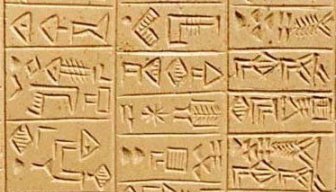
Sumerian Writing
Symbols were made with wedge shaped marks on clay tablets
Writing in ancient Mesopotamia
The earliest written language was created by the Sumerians. The population of Sumer needed a system for keeping track of financial transactions, property rights, and official documents as their settlements expanded into cities. The Sumerians started recording their events on clay tablets with pictorial symbols around 3300 BC.
Clay Tablets
Clay tablets were inscribed with writing. Scribes would push the lines and symbols into the soft, wet clay using a stylus, a rod formed from a reed. When they were finished, they would let the clay set up so that it would become permanent.
Cuneiform
Simple drawings or pictograms were used in the Sumerian people’s earliest writing systems. For instance, the word “head” would be indicated by a depiction of a person’s head. But as time went on, Sumerian writing continued to advance and eventually began to encompass sounds and meanings. The stylus was used by scribes to form wedge-shaped impressions in the clay. Writing of this kind is referred to as cuneiform, which is a term that means “wedge-shaped.”
Translation
For archaeologists today, translating Mesopotamian script is challenging. This is due to the fact that there were over 700 different symbols, and the meanings and shapes of the symbols varied depending on the cities and regions. In addition, the symbols frequently evolved over time. Many Sumerian tablets, though, have been cracked. This is how we are able to understand so much about Mesopotamian history, culture, and governance.
Literature
While financial and administrative records have been found on the majority of the tablets, there are also some literary works among the writings. The mythology of the Mesopotamian gods, stories about their heroes, poetry, and songs are all included in this literature. Wisdom proverbs are included in some of the literature. Gilgamesh is the most well-known and epic work in Mesopotamian literature. For additional information about the Epic of Gilgamesh, click here.
Facts About Sumerian Writing
- Personal seals made of stone, metal, or wood were used to affix signatures on goods.
- Sumerian script was utilized by later Mesopotamian cultures including the Assyrians and Babylonians.
- Cuneiform and hieroglyphics were both developed in Mesopotamia at the same period, although scholars think cuneiform arrived first.
- The Sumerian language is unrelated to any other language spoken today, as far as archaeologists can discover.
- Cuneiform is the method of writing a language, not necessarily a specific language. Initially employed in Mesopotamia to write Sumerian, it was then adapted for Akkadian, a language spoken by the Sumerians, Akkadians, Babylonians, and Assyrians.
Writing in ancient Mesopotamia
Read also : Laws and history of Code of Hammurabi
