 The First Encyclopedia Your First Knowledge Home
Why Cats Bite the Hand They Love

Why Cats Bite the Hand They Love
Sitting there, caressing your favorite cat in a harmless manner, and—ouch! That hurt a lot! You’ve been bitten by your cat. Some will make an unhappy noise, as though it were a warning bite; others will flop on their bellies, seize your hand, and kick.
Your cat is biting regardless of the answer, and it’s not enjoyable. “Why does my cat attack my hand?” is a question you might have. Alternatively, “Why does my cat bite me whenever I pet her?” It depends on the specific situation, body language, and intensity, just like everything else. Some of it may be agitated, aggressive, terrified, or playful. So, let’s examine these factors in more detail.
Why Cats Bite the Hand They Love
The Causes of Cats Biting Humans
Cats typically bite people in a fun manner. The most common perpetrators for excessive biting are kittens, who can stop if the behavior is appropriately changed. At other times, though, it might indicate a shift in behavior or a reaction connected to health.
Let’s look at each one!
-
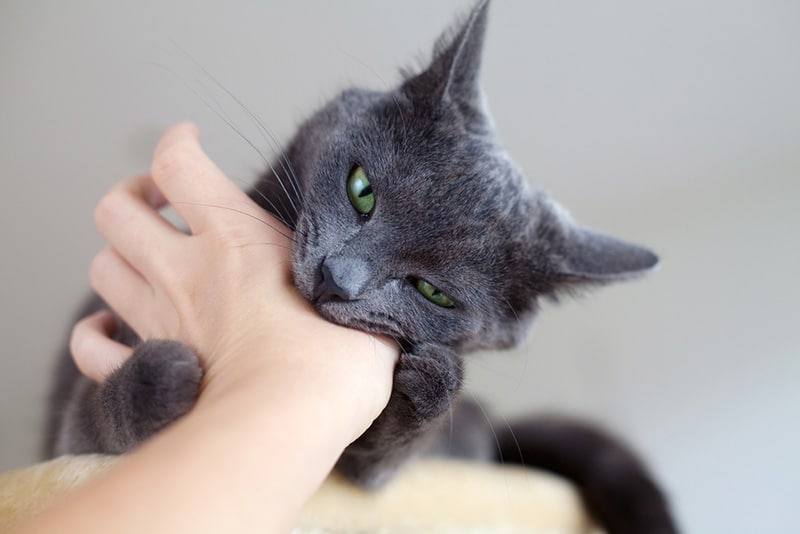
Petting Aggression
It is possible to pet cats that are aggressive. It’s not a sign that your cat dislikes you or intends to harm you if they bite you when you’re caressing them. After a while, it’s quite common for cats to get enough attention. While some cats dislike being stroked and may not put up with it for very long, if at all, others may be extremely tolerant for a very long period.
It’s crucial to respect your cat’s boundaries since they may bite to get you to stop when they’re tired. Examine their body language for minor indications of stress, including a stiff torso, flattened ears, dilated pupils, and tail flicking.
-
Play
When kittens play together or wrestle with human hands, they frequently bite each other in a playful manner. It’s likely that an adult cat who enjoys playing with their hands and feet has been encouraged to do so. From your cat’s perspective, all of these bites are harmless, but they can still cause pain and should be deterred by training.
-
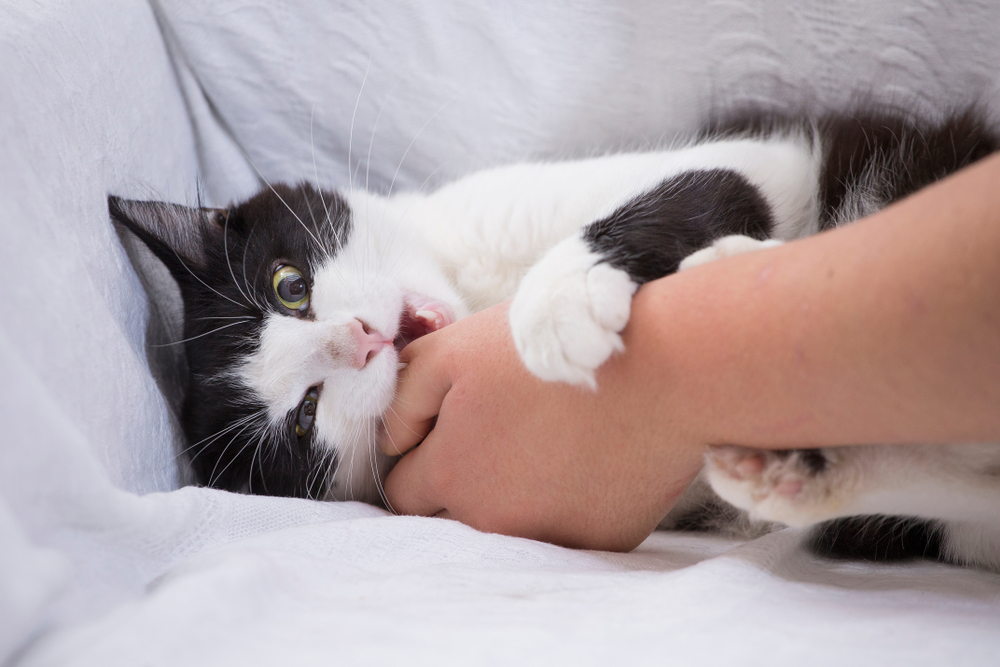
Love Bites
Generally speaking, love bites are far less violent than petting aggressiveness. When your cat is obviously happy, anything can happen. Your cat may bite your hands, limbs, or even your chin if they are enjoying your pet patting! Usually, social grooming (licking) comes before it.
Ouija, my cat, loves nothing more than to bite my chin when I show him extra affection. It only occurs in this kind of environment and usually doesn’t harm. Does it occasionally hurt? Of course! But he only has the best intentions.
-
Fear and Stress
Cats are infamously talkative animals. Their body language and words convey a lot of information. A cat’s whole body probably tells you that they weren’t feeling it long before you touched them if they are biting out of fear. An animal’s body language is a direct indicator of how our contact will proceed; therefore, we must pay attention to it. Don’t attempt to pet a cat if they are physically uncomfortable, have their ears pulled back, begin to snarl, or make vocalizations.
They’re warning you that they don’t want to be involved. In the same way that petting aggressiveness might have more subtle warning flags, review cat behavior and body language. Visitors, remodeling projects, and the addition of additional pets are examples of household changes that might cause stress in cats and possibly reduce their social skills.
-
Health Issues
Several health issues can cause both personality changes and pain. So, if your cat is biting you suddenly, it could very well be because of something going on internally that you can’t see.
Some health issues that may result in biting generally come from those that involve pain or confusion. These could include:
- Hyperthyroidism
- Arthritis
- Hyperaesthesia syndrome
- Cancer
- Injuries
- Spinal issues
- Bladder issues
You need to see your veterinarian right away if you think the health problem might be the root cause of the biting. To ascertain whether anything is amiss or needs additional care, your veterinarian might do a physical examination and blood work.
Go to PangoVet if you need to talk to a veterinarian but are unable to visit one. It’s an online service that allows you to consult a veterinarian and receive cost-effective advice for your pet.
-
Hormones
Our cats’ personalities are greatly influenced by their hormones. Female cats’ behavior may change as a result of hormone changes brought on by heat. It has been demonstrated that males with lower testosterone levels engage in more voluntary interpersonal contact.
In order to avoid any sex hormone-related behaviors (which can be far worse than simply biting), veterinarians frequently advise having your cat fixed around the age of four months.
The Ways to Stop Your Cat From Biting
Cats may bite for a variety of reasons, including play or genuine anger. So, how can you stop it? Unfortunately, since it depends on the underlying problem, there isn’t a universally applicable solution. It’s never a good idea to hit or yell at your cat because this will make them feel scared and confused.
Here are some guidelines for dealing with it after medical illnesses have been ruled out, taking into account the main points we’ve covered.
-
Respect Your Cat’s Personal Space
You will be aware of your cat’s limits when it comes to caressing if you know them well. They will not like it if you push the bounds, regardless of how much, how little, or nothing they allow. It’s possible that your cat doesn’t like what you are doing. Start by caressing the chin, nose, and cheeks because these areas are typically more acceptable than the body, particularly the belly. Additionally, your cat might want additional time to acclimate to you before permitting excessive stroking if you have recently brought them into your home.
-
Redirect Biting to a Toy
Redirect your cat’s attention to a toy or anything visually appealing if they grab hold of you and attempt to bite, whether it’s an aggressive or playful behavior. Over time, they will naturally learn that your hand is not a toy if you consistently demonstrate this to them and offer them what it is.
Exercise is a suitable objective because a lack of physical outlets can also lead to greater distress. Encourage play because cats require two 15-minute play and exercise sessions every day to remain content and healthy.
Are you trying to find toys that will meet your cat’s various needs? One of our favorite cat products is the Hepper Hi-Lo Cat Scratcher, which will motivate your feline to be active. Your cat can climb, stretch, and exercise in a variety of ways thanks to its ingenious three-angle design. Cats can use this scratcher for many years to come because it is made of a durable plywood base and a changeable cardboard insert. The Hepper Catnip Mice Toy Set is a great option for your cat’s natural requirements if they need a little encouragement to play by themselves. packed with organic catnip and made of natural, bite-resistant hessian fabric. Cats can obtain the exercise they require to stay healthy while also satiating their innate hunting drives.
-
Never Play With Your Hands
It is common knowledge that playing with a cat with your hands is never a good idea because it increases biting.
-
Stop Playing Immediately
You should instantly cease playing with your cat if they are acting a bit too rough. Get out of the situation. This type of negative punishment—removing something positive to deter a certain behavior—occurs if your cat is having fun during playtime.
-
Use Your Words
It can be helpful to use words as “second-order reinforcers” to indicate appropriate and inappropriate behavior. It is possible for cats to acquire the meaning of many words. Simply and firmly say no whenever your cat bites you violently, and repeat that every time they do something unwanted. Make sure you do something to let this happen, like halting the playback. If not, the word loses its meaning. This also applies to good behavior. When they are acting appropriately, say “good kitty” and then give them food or another incentive.
-
Seek Professional Help
For assistance in determining the cause of the behavior, consult your veterinarian. Your ability to change your cat’s behavior increases with your understanding of its motivations. Additionally, your veterinarian can rule out any illnesses that might be the source of your cat’s behavior. It takes time and consistency to train animals correctly, and it’s not an easy task. Your veterinarian can assist you in enhancing your training program and ensure that your training methods are correct.
In the end, did you know why cats bite the hand they love?
Summary
In their eyes, it is completely OK for cats to bite you. In addition to being painful, biting can give you the impression that your cat dislikes you. They always have an incentive to bite. It’s critical to rule out any medical issues that can cause pain or discomfort and result in a bite for their welfare. Respect their boundaries if they have them when it comes to petting, and learn to recognize when they’ve had enough. Keep in mind that you also dislike having your personal space invaded. In contrast, you can use training to correct your cat’s behavior if it’s just excessively energetic or exuberant.
Read also: Tips to prevent older cats from eating kitten food
