 The First Encyclopedia Your First Knowledge Home
Technology and Science in Ancient Greece
Learn about technology and science during the civilization of Ancient Greece, including mathematics, astronomy, medicine, biology, inventions, and interesting facts.
Technology and Science in Ancient Greece
Overview
Numerous scientific and technological developments were accomplished by the Ancient Greeks. Greek philosophers started to adopt new perspectives on the world. They developed hypotheses about the workings of the world and believed that research and observation could reveal certain principles that the natural world followed.
Mathematics
The Greeks had a deep fascination with numbers and their practical applications. They created intricate mathematical theories and proofs, studying mathematics for its own sake in contrast to most previous civilizations.
Thales was one of the first Greek mathematicians. Thales studied geometry and developed theories regarding lines, angles, triangles, circles, and angles, including Thale’s theorem. Pythagoras, a different Greek, was likewise interested in geometry. He made the discovery of the Pythagorean Theorem, which is still used to calculate a right triangle’s sides today.
Euclid was arguably the most significant Greek mathematician. Euclid wrote a number of volumes titled Elements that cover geometry. For two millennia, these books served as the de facto textbooks on the subject. There are those who claim that Euclid’s Elements is the most successful textbook ever written.
Astronomy
The Greeks used their mathematical knowledge to describe the planets and stars. They calculated the Earth’s radius very accurately and postulated that the planet might orbit the Sun. They even created what is sometimes referred to as the first computer—a mechanism for calculating the motions of the planets.
Medicine
The Greeks were one of the first civilizations to study medicine as a scientific way to cure illnesses and diseases. They had doctors who studied sick people, observed their symptoms, and then came up with some practical treatments. The most famous Greek doctor was Hippocrates. Hippocrates taught that diseases had natural causes and could sometimes be cured by natural means. The Hippocratic Oath to uphold medical ethics is still taken by many medical students today.
Biology
The Greeks loved to study the world around them, and this included living organisms. Aristotle studied animals in great detail and wrote down his observations in a book called The History of Animals. He heavily influenced zoologists for years by classifying animals according to their different characteristics. Later, Greek scientists continued Aristotle’s work by studying and classifying plants.
Inventions
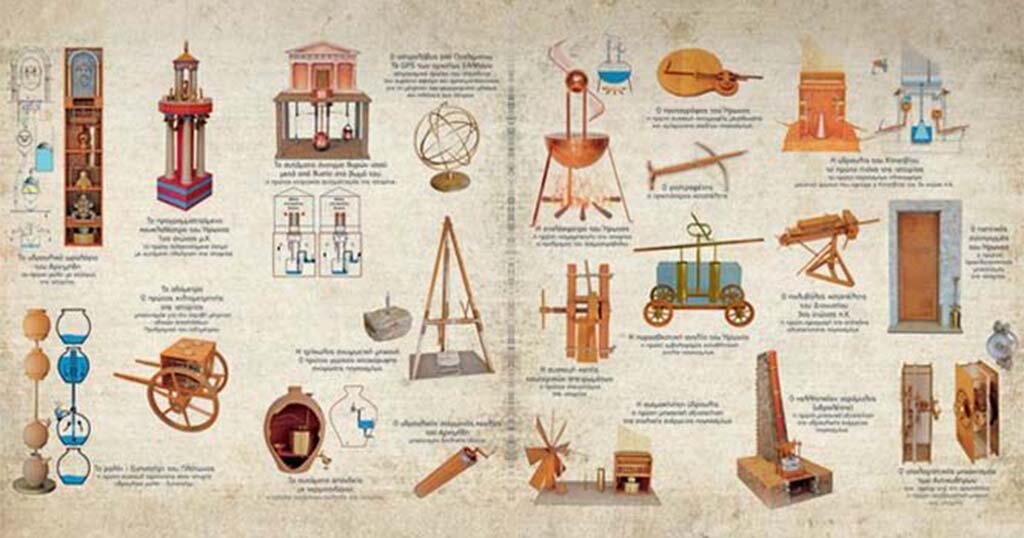
While the Greeks loved to observe and study the world, they also applied their learning to make some practical inventions. Here are some of the inventions that are typically attributed to the Ancient Greeks.
- Watermill: a mill for grinding grain that is powered by water. The Greeks invented the waterwheel used to power the mill and the toothed gears used to transfer the power to the mill.
- Alarm Clock: The Greek philosopher Plato may have invented the first alarm clock in history. He used a water clock to trigger a sound like an organ at a certain time.
- Central Heating: The Greeks invented a type of central heating where they would transfer hot air from fires to empty spaces under the floors of temples.
- Crane: The Greeks invented the crane to help lift heavy items, such as blocks, for constructing buildings.
- Archimedes’ Screw: Invented by Archimedes, the Archimedes’ screw was an efficient way to move water up a hill.
Facts About the Science and Technology of Ancient Greece
- The word “mathematics” comes from the Greek word “mathema,” which means “subject of instruction.”
- Hypatia was head of the Greek mathematics school in Alexandria. She was one of the world’s first famous female mathematicians.
- Hippocrates is often called the “Father of Western Medicine.”
- The word “biology” comes from the Greek words “bios” (meaning “life”) and “logia” (meaning “study of”).
- The Greeks also made contributions to the study of map making or “cartography.”
Read also:Women in Ancient Greece
