 The First Encyclopedia Your First Knowledge Home
Science and Inventions in Renaissance
Learn about Science and Inventions in Renaissance. The inventions and technology of this time in history.
Science and Inventions in Renaissance
What did science do during the Renaissance?
Renaissance Science and Inventions
Science and Art
At this time, science and art were intimately intertwined. To better understand the human body and produce better paintings and sculptures, great artists like Leonardo da Vinci studied anatomy. Mathematical advances were made by architects like Filippo Brunelleschi to create buildings. In those days, the great geniuses were frequently both painters and scientists. Both were seen as skills fit for a real Renaissance man.
The Scientific Revolution
The start of the scientific revolution came close to the end of the Renaissance. Science and mathematics made significant advances during this time. Discoveries made by scientists like Francis Bacon, Galileo, Rene Descartes, and Isaac Newton would alter the course of history.
Printing Press
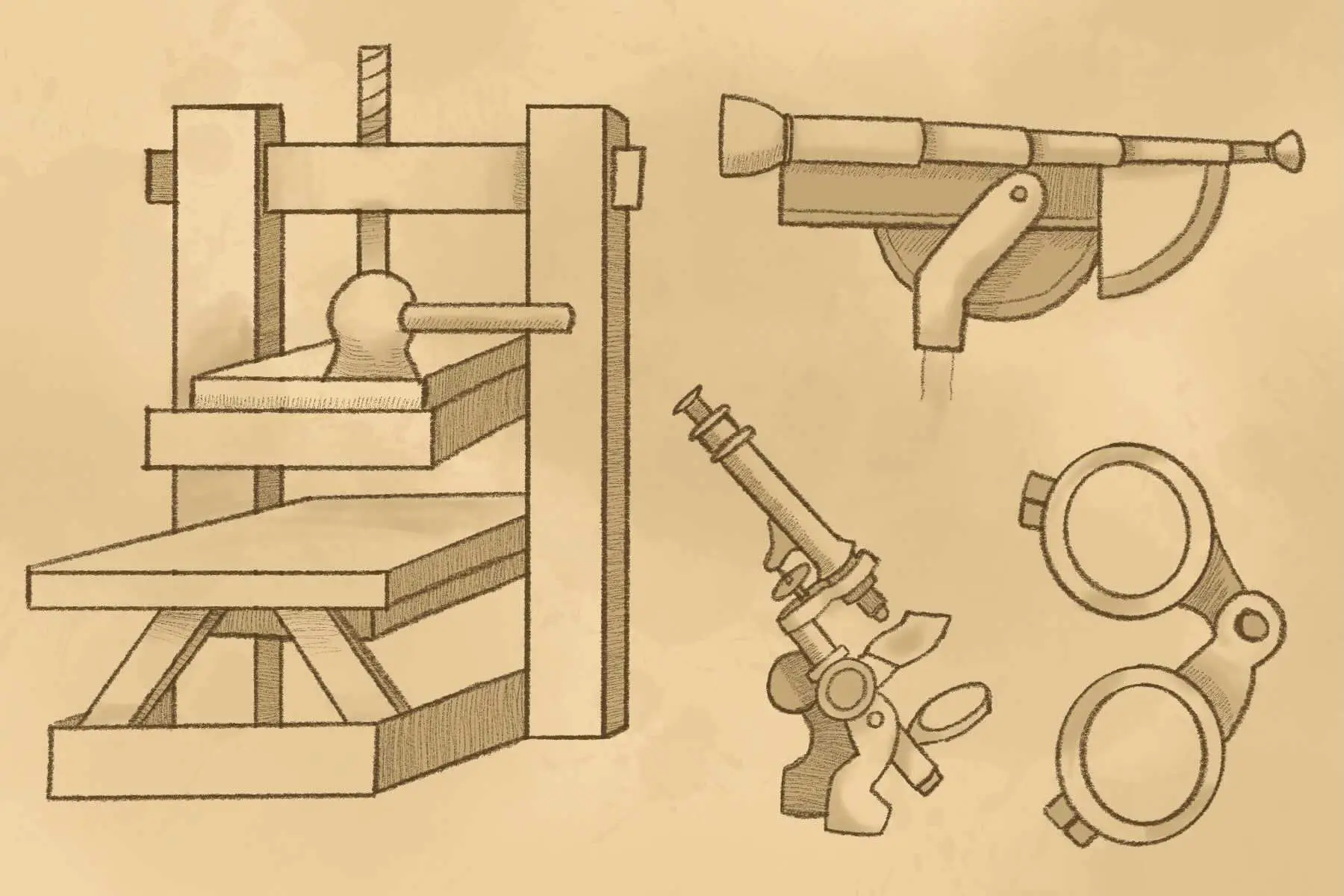
The printing press was the most significant invention of the Renaissance and possibly ever. About 1440, the German Johannes Gutenberg created the printing press. Europe had printing presses by the year 1500. The printing press made it possible to spread knowledge among many people. This promoted the dissemination of new scientific findings and enabled scientists to collaborate and learn from one another.
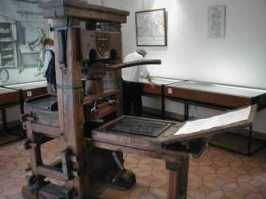
Reproduction of a Gutenberg Printing Press
Photo by Ghw via Wikimedia Commons
Scientific Method
During the Renaissance, the scientific method underwent additional development. Galileo tested his beliefs through well regulated experiments and data analysis. Later, scientists like Francis Bacon and Issac Newton improved the procedure.
Astronomy
Astronomy was the subject of many of the important scientific advancements made during the Renaissance. Famous scientists like Galileo, Kepler, and Copernicus all made significant contributions. This topic was so extensive that we dedicated an entire page to it. Visit our website on Renaissance Astronomy to learn more about it.
Microscope/Telescope/Eyeglasses
Clock
Early Renaissance times saw the creation of the first mechanical clock. Galileo, who created the pendulum in 1581, made improvements. This innovation made it possible to create far more accurate clocks.
Warfare
Moreover, certain inventions helped to advance combat. These featured weapons like muskets and cannons that used gunpowder to discharge metal balls. The Medieval Ages’ castles and knights were doomed as a result of these new weaponry.
Other Inventions
The flushing toilet, the wrench, the screwdriver, wallpaper, and the submarine are a few further inventions from this era.
Alchemy
Alchemy was somewhat similar to chemistry but normally didn’t rely heavily on facts from science. Several people believed that there was a single ingredient that could be used to create all other substances. Finding a way to create gold and become rich was a common goal.
Science and Inventions in Renaissance
Read also : Music and Dance in the Renaissance
