 The First Encyclopedia Your First Knowledge Home
Roman numerals: History and facts
Skills needed:
Multiplication
Addition
Subtraction
Roman numerals: History and facts
The Ancient Romans utilized Roman numerals as their system of numbering. Even now, we still use them occasionally. They appear in outlines, following kings’ names (King Henry IV), in the Super Bowl numbering scheme, and other places. Roman numerals are decimal, or base 10, just like the numbers we use on a daily basis. There is no zero, though they are not totally positional.
Letters are used in place of numbers in Roman numerals. There are seven letters that you must be aware of:
- I = 1
- V = 5
- X = 10
- L = 50
- C = 100
- D = 500
- M = 1000
You put the letters together to make numbers. Here are a few simple examples:
1) III = 3
three I’s together are three 1’s and 1 + 1 + 1 equals 3
2) XVI = 16
10 + 5 + 1 = 16
These examples were simple, but there are a few rules and a few tricky things to know when using Roman numerals:
- The first rule just says that you add letters or numbers if they come after a bigger letter or number. We demonstrated this in example 2 above. The V is less than the X, so we added it to the number. The I was less than the V, so we added it to the number. In rule 3, we’ll discuss what happens when a letter of greater value comes after a letter of lesser value.
- The second rule is that you can’t put more than three letters together in a row. For example, you can put three I’s together, III, to make a 3, but you can’t put four I’s together, IIII, to make a 4. How do you make a 4, then? See rule number three.
- You can subtract a number by putting a letter of lower value before one of higher value.
-
- IV = 5 minus 1 = 4
- IX = 10 minus 1 = 9
- XC = 100 minus 10 = 90
-
- You can only subtract one number. You can’t get a 3 by writing IIV.
- You can only do this with I, X, and C. Not with V, L, or D.
- The smaller (subtracted) letter must be either 1/5th or 1/10th the larger one. For example, 99 cannot be written IC because I is 1/100th of C.
- The last rule is that you can put a bar over a number to multiply it by a thousand and make a really big number.
This is how we make the numbers four, nine, and ninety:
There are a few restrictions on when you can do this:
Examples:
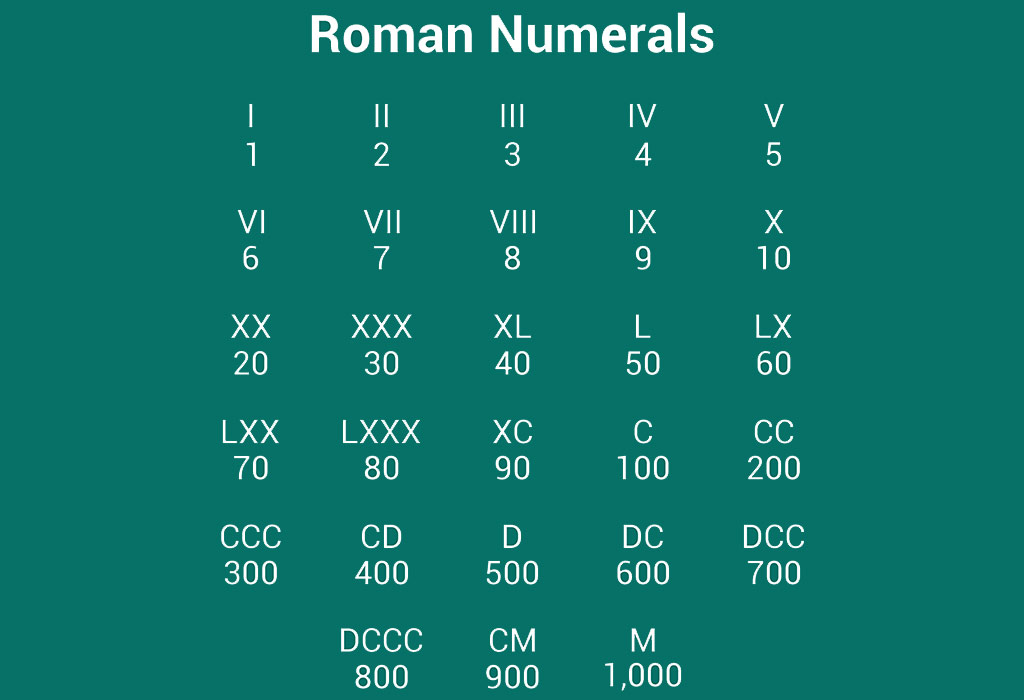
The numbers 1 through 10 are:
I, II, III, IV, V, VI, VII, VIII, IX, X
The tens (10, 20, 30, 40, 50, 60, 70, 80, 90, 100):
X, XX, XXX, XL, L, LX, LXX, LXXX, XC, C
Read also: Engineering and construction in ancient Rome
