 The First Encyclopedia Your First Knowledge Home
Reconquista: History and Facts

Reconquista: History and Facts
What was the Reconquista?
The Christian Kingdoms and the Muslim Moors engaged in a protracted conflict and battle for control of the Iberian Peninsula, which came to be known as the Reconquista. It spanned from 718 until 1492, a significant period of the Middle Ages.
What is the Iberian Peninsula?
The Iberian Peninsula is situated in Europe’s far southwest. These days, Spain and Portugal make up the majority of the peninsula. The Pyrenees Mountains, the Mediterranean Sea, and the Atlantic Ocean all surround it.
Who were the Moors?
Muslims, known as the Moors, inhabited Algeria and Morocco in northern Africa. The Iberian Peninsula was referred to as “Al-Andalus” by them.
The Moors Invade Europe
The Moors invaded the Iberian Peninsula in 711 after traveling across the Mediterranean from North Africa. They conquered most of the peninsula and made headway into Europe during the course of the following seven years.
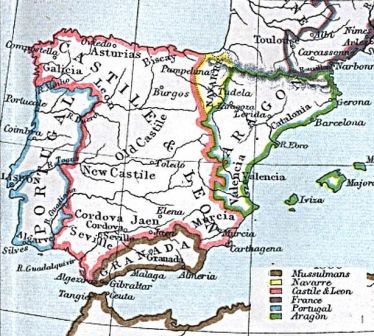
start of the Reconquista
At the Battle of Covadonga in Alcama in 718, Visigoth King Pelayo overcame the Muslim army, sparking the start of the Reconquista. This was the Christians’ first notable triumph over the Moors.
Many Battles
The Christians and the Moors engaged in combat over the course of the following few centuries. The Moors’ assault would be stopped at France’s borders by Charlemagne, but it would take more than 700 years to retake the peninsula. Both sides won and lost a great deal of battles. Civil wars and internal power conflicts also occurred on both sides.
The Catholic Church
The Reconquista was viewed as a holy war in its later stages, much like the Crusades. The Catholic Church advocated for the expulsion of Muslims from Europe. During the Reconquista, a number of religious military groups, including the Knights Templar and the Order of Santiago, participated.
Fall of Granada
Following years of warfare, Spain came together with the marriage of King Ferdinand of Aragon and Queen Isabella I of Castile in 1469. The Moors, however, continued to rule over Granada. After that, Ferdinand and Isabella directed their combined forces against Grenada, regaining it in 1492 and bringing an end to the Reconquista.
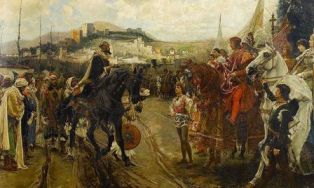
Timeline of the Reconquista
- 711: The Moors conquer the Iberian Peninsula.
- 718: The Reconquista begins with the victory of Pelayo at the Battle of Covadonga.
- 721: The Moors are turned back from France with a defeat at the Battle of Toulouse.
- 791: King Alfonso II becomes King of Asterieas. He will firmly establish the kingdom in northern Iberia.
- 930–950: The King of Leon defeats the Moors in several battles.
- 950: The Duchy of Castile is established as an independent Christian state.
- 1085: Christian warriors capture Toledo.
- 1086: The Almoravids arrive from North Africa to help the Moors push back the Christians.
- 1094: El Cid takes control of Valencia.
- 1143: The Kingdom of Portugal is established.
- 1236: By this date, half of Iberia had been retaken by Christian forces.
- 1309: Fernando IV takes Gibraltar.
- 1468: Ferdinand and Isabella unite Castile and Aragon into a single, united Spain.
- 1492: The Reconquista is complete with the fall of Granada.
Facts about the Reconquista
- During the Second Crusade, Crusaders passing through Portugal helped the Portuguese army to retake Lisbon from the Moors.
- The national hero of Spain, El Cid, fought against the Moors and took control of the city of Valencia in 1094.
- King Ferdinand and Queen Isabella were called the “Catholic Monarchs”.
- It was Ferdinand and Isabella who authorized the expedition of Christopher Columbus in 1492.
- After the Reconquista, Muslims and Jews who lived in Spain were forced to convert to Christianity or they were expelled from the country.
Read also: Norman Conquest: History and Facts
