 The First Encyclopedia Your First Knowledge Home
Medieval Knight’s Armor and Weapons
A knight’s armor, swords, and war horse were his most prized possessions. Due to the high cost of these three goods, only the wealthy could afford to wear knightly clothing. When knights overran the towns and cities of their enemies, many of them intended to recover a portion of the cost through pillage.

Medieval Knight’s Armor and Weapons
Armor
Knights in the Middle Ages wore bulky metal armor. Chain mail and plate armor were the two primary categories of armor.
Chain mail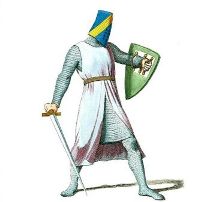
Tiny metal rings were used to make chain mail. The hauberk, a long cloak, was the standard piece of chain mail armor. In order to lessen the impact of the armor, knights donned a cushioned cloak below their armor. A thirty-pound chain mail hauberk might be present.
Even though chain mail was pliable and provided decent defense, a thin sword or an arrow might pierce it. Some knights started covering important body parts with metal plates to increase their safety. They soon wore no more chain mail and were entirely encased in plate armor.
Plate armor
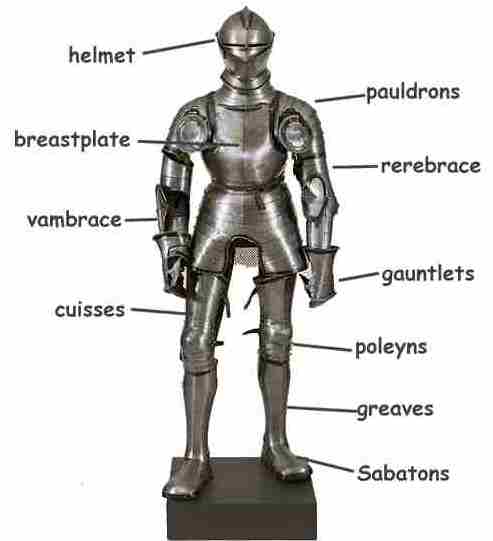
The majority of knights wore full-plate armor by the 1400s. Although this armor provided more protection over chain mail, it was heavier and less flexible. An entire plate armor outfit weighed about sixty pounds. Every piece of armor had a special name.
Here are some of the different pieces of plate armor and what they protected:
Greaves (ankles and calves)
Sabatons: feet
Poleyns: knees
Cuisses: thighs
Gauntlets: hands
Vambrace: lower arms
Pauldron, shoulders
Breastplate: chest
Rerebrace: upper arms
Helmet: head
Weapons
Medieval knights employed a wide range of weaponry. Certain weapons, like the lance, were more useful for charging on horseback, while other weapons, like the sword, were better suited for hand-to-hand fighting.
- Lance: The lance was a long wooden pole with a metal tip and hand guards. Because the lance was so long, the knight could attack from his horse. This gave the knight a serious advantage against foot soldiers. The lance could also be used to knock enemy knights off of their horses.
- Sword: The sword was the preferred weapon once the knight had dismounted or if his lance was broken during battle. Some knights preferred a one-handed sword and a shield, while others preferred a larger, two-handed sword.
- Mace: The mace was a club with a big steel head. These weapons were designed to crush an enemy.
- Longbow: Many knights considered the longbow to be a cowardly weapon. However, the longbow became a major part of winning battles in the Middle Ages. The longbow could attack from a distance or a castle wall.
War Horse
The knight’s war horse was among his most prized belongings. This horse had combat training. It would not back down from battle or bloodshed. For a knight, a war horse of quality may spell the difference between life and death.
We refer to the battle horse used by knights as a destrier. In addition, the horse was protected by armor consisting of metal plates covering its head, neck, and sides.
Siege Weapons
Knights also needed to be proficient with siege weaponry. These were unique weapons that were employed in castle capture.
- Belfry: The belfry was a tall, rolling tower that would allow soldiers to safely approach the castle walls. Once they reached the castle, they would exit the tower onto the top of the walls.
- Catapult: A catapult could throw huge boulders onto the walls of the castle. These boulders could break down the walls and destroy buildings inside the castle.
- Battering ram: The battering ram was a huge, heavy log used to smash down the gates of the castle.
Facts about a Knight’s Armor and Weapons
- Knights had to practice putting on and wearing their armor. It took skill to ride a horse and fight with such heavy armor on.
- A plate mail armor suit was sometimes known as a harness.
- Sometimes war horses were fitted with iron horse shoes which could be used as weapons against foot soldiers.
- Some two-handed swords were well over five feet long.
Read also: Medieval Knight: History and Facts
