 The First Encyclopedia Your First Knowledge Home
Biography of Isaac Newton : Discovered the theory of gravity and the three laws of motion.
Learn about Isaac Newton biography. Scientist who made the discoveries of calculus, the three laws of motion, and gravity. He is considered one of the great scientists in history.

Who is Isaac Newton ?
Isaac Newton biography
- Occupation: astronomer , Scientist and mathematician
- Born: in England January 4, 1643
- Died: in England March 31, 1727
- Best known for: Defining the global gravitational force and the three laws of motion
Biography of Isaac Newton
One of the most influential scientists in history is Isaac Newton. Isaac Newton was regarded as the smartest person to have ever lived, according to Albert Einstein. Newton made significant contributions to science throughout his lifetime, including the development of the theory of gravity, the laws of motion (which served as the foundation for physics), calculus, a brand-new branch of mathematics, and the reflecting telescope.
Early Life
Isaac Newton was born in Woolsthorpe, England on January 4, 1643. His father, a farmer who was also named Isaac Newton, had died three months before his birth. His mother remarried when Isaac was three years old and left young Isaac in the care of his grandparents.
Isaac attended school where he was an adequate student. At one point his mother tried to take him out of school so he could help on the farm, but Isaac had no interest in becoming a farmer and was soon back at school.
Isaac grew up mostly alone. For the rest of his life he would prefer to work and live alone focused on his writing and his studies.
College and Career
In 1661, Isaac began to attend college at Cambridge. He would spend much of his life at Cambridge, becoming a professor of mathematics and a fellow of the Royal Society (a group of scientists in England). He eventually was elected to represent Cambridge University as a member of parliament.
Isaac had to leave Cambridge from 1665 to 1667 because of the Great Plague. He spent these two years in study and isolation at his home in Woolsthorpe developing his theories on calculus, gravity, and the laws of motion.
In 1696 Newton became the warden of the Royal Mint in London. He took his duties seriously and tried to get rid of corruption as well as to reform the currency of England. He was elected President of the Royal Society in 1703 and was knighted by Queen Anne in 1705.
The Principia
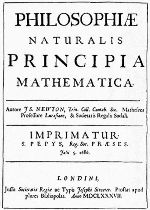
In 1687 Newton published his most important work called the Philosophiae Naturalis Principia Mathematica (which means “Mathematical principals of Natural Philosophy”). In this work he described the three laws of motion as well as the law of universal gravity. This work would go down as one of the most important works in the history of science. It not only introduced the theory of gravity, but defined the principals of modern physics.
Scientific Discoveries
Isaac Newton made many scientific discoveries and inventions throughout his career. Here is a list of some of the most important and famous ones.
- Gravity – Newton is probably most famous for discovering gravity. Outlined in the Principia, his theory about gravity helped to explain the movements of the planets and the Sun. This theory is known today as Newton’s law of universal gravitation.
- Laws of Motion – Newton’s laws of motion were three fundamental laws of physics that laid the foundation for classical mechanics.
- Calculus – Newton invented a whole new type of mathematics which he called “fluxions.” Today we call this math calculus and it is an important type of math used in advanced engineering and science.
- Reflecting Telescope – In 1668 Newton invented the reflecting telescope. This type of telescope uses mirrors to reflect light and form an image. Nearly all of the major telescopes used in astronomy today are reflecting telescopes.
Legacy
Newton died on March 31, 1727 in London, England. Today, he is considered one of the most influential scientists of all time alongside greats such as Albert Einstein, Aristotle, and Galileo.
Facts about Isaac Newton
- He studied many classic philosophers and astronomers such as Aristotle, Copernicus, Johannes Kepler, Rene Descartes, and Galileo.
- Legend has it that Newton got his inspiration for gravity when he saw an apple fall from a tree on his farm.
- He wrote his thoughts down in the Principia at the urging of his friend (and famous astronomer) Edmond Halley. Halley even paid for the book’s publication.
- He once said of his own work “If I have seen further than others, it is by standing upon the shoulders of giants.
Read also : James Naismith biography
