 The First Encyclopedia Your First Knowledge Home
Renaissance : Elizabethan Era
Learn about the Elizabethan Era including the English Renaissance, theatre, arts, clothing, fashion, and fun facts.
Elizabethan Era
Many historians view the Elizabethan Period, which spanned from 1558 to 1603, as the pinnacle of English history. England was peaceful and prosperous during this time, and the arts were in vogue. Elizabeth I, the monarch who ruled England during this time, is honored by having her reign honored.
English Renaissance Theatre
The theatre and William Shakespeare’s works are undoubtedly the two most well-known aspects of the Elizabethan era. The “Red Lion” theater’s opening in 1567 marked the beginning of English Renaissance theater. Throughout the ensuing years, London saw the establishment of numerous additional permanent theaters, including the Curtain Theatre in 1577 and the renowned Globe Theatre in 1599.
Some of the greatest playwrights in history, including Christopher Marlowe and William Shakespeare, were born during this time. Shakespeare is now regarded as the greatest English-language author. Drama, comedy, and history plays were all common types of theater.
Other Arts
The Elizabethan Period saw a flourishing of other arts besides theater. Popular forms of art at the time included music and painting. Important composers from the time were William Byrd and John Dowland. English artists like Nicholas Hilliard and George Gower, a personal favorite of Queen Elizabeth, started to emerge as well.
Navigation and Exploration
With the defeat of the Spanish Armada in 1588, the English fleet rose to prominence throughout the Elizabethan era. Improvements in navigation were also made, which were highlighted by Sir Francis Drake’s successful round of the globe. Sir Walter Raleigh, who founded the Virginia Colony, and Sir Humphrey Gilbert, who discovered Newfoundland, were two more notable English explorers.
Clothing and Fashion
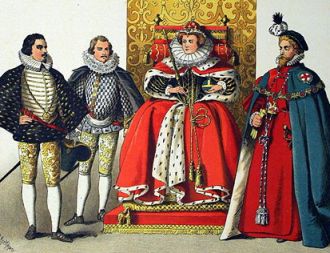
Nobles and the rich at this time placed a high value on clothing and fashion. It was actually against the law to wear certain sorts of clothing, according to the legislation. For instance, ermine fur trimming was exclusively permitted on royal family attire. The nobles wore extremely opulent silk and velvet clothing. They wore vivid colors, and their wrists and collars were ruffled heavily.
Formation of the government
The monarch, the Privy Council, and the Parliament comprised the convoluted three-part administration of this age in England.
Queen Elizabeth ruled the country. She was extremely strong and responsible for most of the laws in the country, but she needed Parliament’s permission to enact taxes. The closest advisers to the queen made up the Privy Council. They would counsel her and provide suggestions. The Privy Council had 50 members when Elizabeth became queen for the first time. By 1597, there were only 11 members left thanks to her gradual reduction of this.
Two groupings were in the parliament. High ranking members of the church, including bishops, made up one group known as the House of Lords, which was composed of nobles. The House of Commons, which was composed of commoners, was the other group.
Facts about the Elizabethan Era
- Thomas Gresham founded the Royal Exchange, the country’s first stock exchange, in 1565.
- Protestant Queen Elizabeth was frequently threatened with assassination by Catholics who wanted Mary, Queen of Scots to take her place.
- Around this time, coaches became a fairly common form of transportation for the affluent and nobles in England.
- Elizabeth the Queen never got married and never had kids. She claimed that she was wed to her nation.
- English poetry, particularly the sonnet, was in vogue. William Shakespeare and Edmund Spenser were both well-known poets.
Read also : Age of Exploration in Renaissance
