 The First Encyclopedia Your First Knowledge Home
Biography of Eli Whitney : made the cotton gin possible.
Learn about the biography and life of Eli Whitney including his early career, invention of the cotton gin, impact on the Civil War, and interesting facts

Who is Eli Whitney ?
Eli Whitney biography
- Occupation: innovative
- Born: in Massachusetts December 8, 1765
- Died: in Connecticut January 8, 1825
- Best known for: cotton gin
Biography of Eli Whitney
Eli Whitney’s development of the cotton gin altered the trajectory of history in the southern United States. It enabled numerous southern plantation owners to profit greatly from their cotton harvests. The demand for slaves rose as a result, nevertheless.
Where did Eli Whitney grow up?
Eli Whitney was born on December 8, 1765 in Westborough, Massachusetts to Eli and Elizabeth Whitney. Growing up on the farm with his two brothers and one sister, Eli enjoyed working in his dad’s workshop.
Young Eli was more interested in tools and machines than farming. He liked to figure out how things worked. One day, he took apart his father’s valuable watch to see how it worked. Then he realized he would have to put it back together or he would be in huge trouble. He carefully reassembled the small pieces and, luckily for Eli, the watch worked just fine.
Early Career
After high school, Whitney attended Yale College. There he studied a variety of subjects including mathematics, Greek, Latin, and philosophy. Upon graduating in 1792, he hoped to study law, but was short on money so he accepted a job as a tutor in Georgia.
While traveling to Georgia, Whitney met a lady named Mrs. Greene. Mrs. Greene was the widow of the Revolutionary War hero General Nathaniel Greene. She owned a large plantation called Mulberry Grove in Georgia. The two became friends and Whitney decided to turn down his tutor job and stay at Mulberry Grove.
Different Kinds of Cotton
While at Mulberry Grove, Whitney learned about the production of cotton. He discovered that most plantations could only grow a type of cotton called “short staple” cotton. However, short staple cotton was difficult and expensive to clean. The seeds had to be removed by hand. For this reason, many plantation owners in the South had stopped growing cotton.
The Cotton Gin
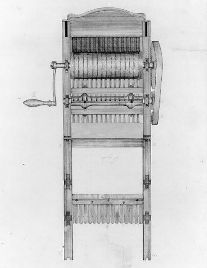
The Cotton Gin
Whitney enjoyed building machines and solving problems. He thought he could come up with something to help clean the seeds from the cotton. That winter, Eli invented a machine he called the cotton gin. He used a wire screen in combination with small hooks to pull the cotton fibers through. His new machine could clean more cotton in a few hours than a number of workers could in a day.
Fighting over Patents
With the help of his business partners, Whitney got a patent for his new invention and made plans to make his fortune. However, things didn’t work out for him. People just copied his new machine and he got nothing. He tried to fight them in court, but ran out of money.
Impact on Slavery
Although Whitney didn’t become rich over his patent, many plantation owners in the South did. They were now able to make a lot of money off cotton crops using the cotton gin. This had the unintended consequence that more enslaved people were needed to pick cotton from the fields. Over the next several years, the enslaved became even more important and valuable to plantation owners. Some historians point to the cotton gin’s impact on slavery as an eventual cause to the Civil War.
Later Life and Death
Although Whitney didn’t get rich off the cotton gin, he did become famous. He used his fame to push the idea of interchangeable parts for manufacturing. Whitney secured a contract from the government to manufacture muskets. He played an important role in advancing the idea of mass-production.
Whitney died on January 9, 1825 of cancer.
Facts about Eli Whitney
- The “gin” in “cotton gin” is a shortened version of the word “engine.”
- As a child he built a fiddle in his father’s workshop. It sounded great. After that, the local musicians would bring their instruments to Eli for repairs.
- Before going to college, he manufactured nails in his father’s workshop during the Revolutionary War.
- Whitney was over 50 when he married, but had four children before he died at 59.
Read also : Louis Pasteur biography
