 The First Encyclopedia Your First Knowledge Home
Chinese Grand Canal
learn about Chinese Grand Canal of Ancient China including its history, when it was built, improvements, length, why it was built, and fun facts
What is The Grand Canal?
In eastern China, there is a man-made waterway called the Grand Canal that travels north and south. It is the world’s longest man-made canal.
How long is the Canal?
The canal travels more than 1,100 kilometres between Beijing and Hangzhou. The canal between Beijing and Hangzhou is another name for it. It also links the Yangtze River and the Yellow River, China’s two largest rivers, in addition to these two significant cities.
Why was the Grand Canal constructed?
The canal was constructed to make it simple to transport grain from the abundant farmland in southern China to Beijing, the nation’s capital. The soldiers manning the northern borders were also fed thanks to the emperors.
Early Canals
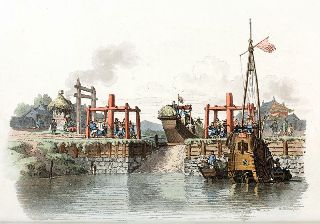
Early canals were constructed in China by the ancient Chinese to aid with trade and transportation. The Han Gou Canal, constructed by Kin Fuchai of Wu in roughly 480 BC, was one of the first sections. From the Yangtze River to the Huai River, this canal was present.
The Hong Gou Canal, which connected the Yellow River and the Bian River, was another historic canal. Over a thousand years later, the Grand Canal was built on top of these prehistoric canals.
construct the Grand Canal
The Sui Dynasty is when the Grand Canal was constructed. Emperor Yang of the Sui desired a faster and more effective method of delivering grain to Beijing, his capital city. In addition, he had to feed his army, which was defending northern China from the Mongols. He made the decision to link the already-existing canals and enlarge them so that they extended from Beijing to Hangzhou.
It took a long time to build the canal. Millions of workers put in over six years’ worth of arduous effort. Yang the Emperor was a despot. He made millions of farmers labor on the canal under duress. The construction claimed the lives of many of them. However, China got a new waterway when the canal was ultimately finished in 609 AD, which would benefit the nation for hundreds of years to come.
Later Improvements
Early in the fourteenth century, the Ming Dynasty reconstructed much of the canal. To control the canal’s water level, they deepened the canal, added more locks, and built reservoirs. Grain transportation remained the canal’s primary objective. This persisted for the majority of ancient Chinese history, including the Ming Dynasty.
Facts about the Grand Canal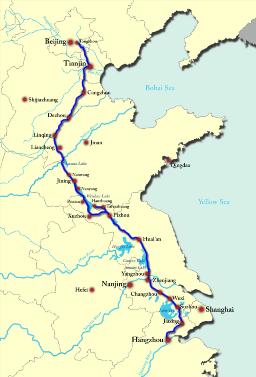
- Historians estimate that the oldest section of the canal was built around the 6th century BC.
- Emperors would sometimes travel along the Grand Canal to inspect the locks.
- It is estimated that it took over 45,000 full-time laborers to maintain the canal during the Ming Dynasty.
- The canal was also used as a courier route for carrying important government messages.
- In the 1400s, the Chinese government operated over 11,000 grain barges on the canal to transport food to the north.
- The Grand Canal also proved to be an excellent source of taxes for the Chinese government.
- Portions of the canal fell into disrepair after the Yellow River flooded in 1855.
- The pound lock was invented during the Song Dynasty in 984 AD to help raise and lower the water level of the canal.
Read also : The Terracotta army History and facts
