 The First Encyclopedia Your First Knowledge Home
Biography of Hatshepsut – One of the most powerful and successful pharaohs of Ancient Egypt.
Learn about the biography of Hatshepsut of Ancient Egypt.
A famous and powerful woman Egyptian pharaoh.
- Occupation: Pharaoh of Egypt
- Born: 1508 BC
- Died: 1458 BC
- Best known for: The most powerful woman pharaoh
Biography of Hatshepsut :

A Princess
Hatshepsut was conceived an Egyptian princess. Her dad was the Pharaoh Thutmose I. She experienced childhood in the extraordinary imperial courts of Egypt with her sister and two siblings. Sadly, Hatshepsut’s siblings and sister passed on while they were as yet youthful. Presently she was a lone youngster.
Without a son to inherit the throne, Thutmose I was worried who would be pharaoh after he died. He decided to name one of Hatshepsut’s step-brothers as heir. This is where things get weird. Hatshepsut was married to her step-brother in order to keep the royal line pure. This sounds really strange today, but it was common for Egyptian royalty.
A Queen
Hatshepsut’s dad died a short time after she was married and her husband became the pharaoh Thutmose II. Hatshepsut was now queen of Egypt. Thutmose II, however, was a sickly man. He ruled for only a few years before he died. During this time Hatshepsut had begun to take an active role in running the country. Egypt faced a problem, though. Hatshepsut had not had a son with Thutmose II. Now what would Egypt do for a leader?
Regent
The only male heir to the throne was a young boy that was Hatshepsut’s nephew Thutmose III. He was crowned the new pharaoh of Egypt at a young age, but Hatshepsut was named regent. She would run the country for him.
Becoming Pharaoh
Hatshepsut was a powerful and intelligent leader. There were people in the government who were very loyal to her. After a few years of being regent, she decided to become Pharaoh. She had herself named Pharaoh. She took charge of the country.
Ruling Egypt
Hatshepsut was a gifted and cunning leader. She had to be to remain in power for 20 years as a woman pharaoh. Rather than go to war, she established trade relationships with many foreign countries. Through trade she made Egypt a rich nation. Her time of rule was a time of peace and prosperity.
Building
One way that Hatshepsut stayed in power was to construct many buildings and monuments throughout Egypt. She also had many statues of herself at these sites. This way the people continued to think of her as their leader and pharaoh.
One of her most famous buildings was her mortuary temple at Djeser-Djeseru. This temple is considered one of the great achievements in Egyptian architecture. It was similar to the classical architecture that the Greeks would develop around a thousand years later and marked a major turning point in Egyptian architecture.
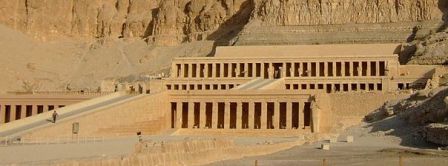
Temple of Hatshepsut by Gocht
Dressing like a Pharaoh
In order for people to accept her as pharaoh, Hatshepsut began to dress like a pharaoh. She wore the pharaoh’s headdress with a cobra. She even wore a fake beard and a short kilt like the men wore.
Death
After 22 years of rule Hatshepsut died. No one is sure how she died, but it may have been cancer. Thutmose III then came into full power as Pharaoh by himself. He would later become known as a great Pharaoh in his own right.
Interesting Facts about Hatshepsut
- The name Hatshepsut means “Foremost of Noble Ladies”.
- Her father Thutmose I was a general, but became Pharaoh because the previous Pharaoh did not have a son.
- Archeologists think that Thutmose III had many of the statues and references to Hatshepsut destroyed.
- As a way to justify becoming pharaoh, she claimed that she was the daughter of the god Amun.
- Her nephew Thutmose III was known as the “Napoleon of Egypt” because of how he expanded the Egyptian Empire through war.
read more : Biography of Queen Elizabeth I
