 The First Encyclopedia Your First Knowledge Home
Biography of Hannibal
One of the greatest military commanders of antiquity, Hannibal was a Carthaginian general who led the Carthaginian forces against Rome in the Second Punic War (218–201 bce) and persisted in opposing Rome and its satellites until his death. Hannibal was born in North Africa in 247 BC and died in Libyssa, Bithynia [near Gebze, Turkey].
Biography of Hannibal
Many people rank Hannibal Barca as one of the greatest generals in history. He devoted his entire life to fighting Rome as the commander of the Carthaginian army.
Biography of Hannibal
Growing Up
The city of Carthage is where Hannibal was born. On the Mediterranean Sea coast of North Africa, which is now Tunisia, once stood the great metropolis of Carthage. For a long time, Carthage was the Roman Republic’s main adversary in the Mediterranean. During the First Punic War, Hannibal’s father, Hamilcar Barca, was a general in the Carthaginian army and had engaged Rome in combat.
As a child, Hannibal aspired to join his father’s military unit. He had several sisters and two brothers, Hasdrubal and Mago. Hannibal asked to accompany his father on his trip to the Iberian Peninsula (Spain) in order to secure Carthage’s dominance over the area. Hannibal had to take a sacred pledge promising to always be Rome’s enemy before his father would allow him to enter.
Early Career
Hannibal advanced through the army ranks swiftly. His father taught him the art of becoming a general and a leader. But when Hannibal was eighteen years old in 228 BCE, his father passed away. Hannibal studied under his brother-in-law Hasdrubal the Fair for the next eight years. Hannibal was appointed general of the Carthaginian army in Iberia following the assassination of Hasdrubal by a slave.
During his initial years as a general, Hannibal carried on his father’s Iberian Peninsula conquest. He expanded Carthage’s dominion over multiple cities. Rome, however, soon started to worry about Hannibal’s army’s power. They formed a coalition with the Spanish coast city of Saguntum. The Second Punic War started when Rome waged war on Carthage after Hannibal took control of Saguntum.
Second Punic War
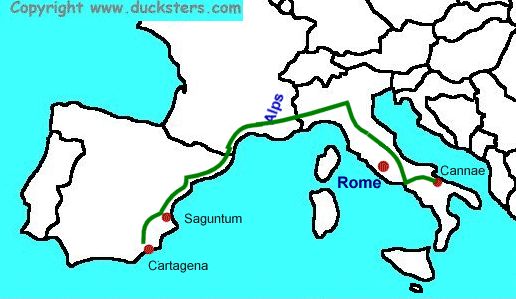
Hannibal made the decision to fight at Rome. His army would march overland via Gaul (France), Spain, the Alps, and Italy. His goal was to subjugate Rome. In the spring of 218 BCE, his army left the Spanish coast city of New Carthage (Cartagena).
Crossing the Alps
The army of Hannibal moved swiftly in the direction of Italy, eventually reaching the Alps. The towering mountains of the Alps had challenging weather and topography. Because they believed that no general would dare lead their army via the Alps, the Romans felt secure. But Hannibal performed the unimaginable and led his army over the Alps. The exact number of soldiers Hannibal had when he crossed the Alps is unknown to historians, but it was most likely between 40,000 and 90,000. He also possessed 37 elephants and about 12,000 cavalry. Hannibal’s force was much diminished when he crossed the Alps. With about 20,000 infantry, 4,000 cavalry, and a few elephants, he arrived in Italy.
Battles in Italy
At the Battle of Trebia, Hannibal fought the Roman army after crossing the Alps. But initially, he attracted more soldiers from the Po Valley Gauls who desired to topple Roman authority. At Trebia, Hannibal decisively beat the Romans and proceeded to push on Rome. The Battle of Lake Trasimene and the Battle of Cannae were two of the many victories Hannibal continued to have over the Romans.
A Long War and Retreat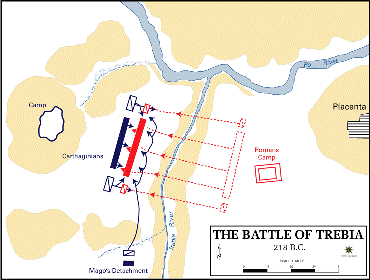
Before they could be halted, Hannibal and his army had come close to Rome. The battle had now reached a standstill. For several years, Hannibal remained in Italy and engaged Rome in combat. But with more numbers, the Romans were able to gradually decimate Hannibal’s force. In 203 BCE, some fifteen years after his arrival in Italy, Hannibal withdrew back to Carthage.
End of the War
After arriving back in Carthage, Hannibal readied the troops for Rome’s onslaught. At the Battle of Zuma in 202 BCE, the Second Punic War came to a close. The Romans ultimately vanquished Hannibal at Zuma. Rome was compelled to sign a peace treaty granting Carthage sovereignty over Spain and the Western Mediterranean.
Later Life and Death
Hannibal entered politics in Carthage following the conflict. For a while, he was regarded as a distinguished statesman. He still despised Rome, nonetheless, and desired its destruction. After that, he fled to Turkey and planned an attack on Rome. In 183 BCE, as the Romans pursued him, he escaped to the countryside and poisoned himself to avoid being apprehended.
Facts about Biography of Hannibal
- The Romans used trumpets to frighten Hannibal’s elephants and cause them to stampede.
- The name “Hannibal” became a symbol of fear and terror to the Romans.
- He is often listed as one of the greatest military generals in world history.
- The name “Barca” means “thunderbolt.”
- He was elected to be the “suffete”, the top government position in the city of Carthage. While suffering, he reformed the government, including reducing the term limits of officials from life to two years.
Read also: Boers of South Africa: History and Facts
