 The First Encyclopedia Your First Knowledge Home
Art and Literature in Middle Ages
The style of art during the Middle Ages varied depending on where in Europe you were and when you lived. Nonetheless, Byzantine, Romanesque, and Gothic art are the three primary eras and styles that comprise Middle Ages art. During the Middle Ages, Catholic themes and subjects dominated a large portion of religious art in Europe. Manuscripts, paintings, sculptures, metalwork, engravings, and stained glass windows were among the various forms of art.
The beginning of the Renaissance Period marks a significant shift in art that frequently heralds the end of the Middle Ages.

Art and Literature in Middle Ages
Byzantine Art
Many refer to the beginning of the Middle Ages as the “Dark Ages.” This time frame spans from 500 to 1000 AD. Byzantine art, created by artists from the Eastern Roman Empire, often known as Byzantium, was the predominant artistic medium during that period.
One characteristic of Byzantine art was its lack of reality. Instead of attempting to create realistic paintings, the painters concentrated on their work’s symbolism. The subjects of paintings were typically somewhat serious and gloomy, and they were flat with no shadows. Nearly all of the paintings’ subjects were religious; Christ and the Virgin Mary appeared in numerous works.
Romanesque Art
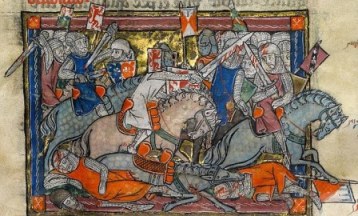
Around 1000 AD marked the beginning of the Romanesque art period, which ended around 1300 with the start of the Gothic art period. Pre-Romanesque art is that which predates that. Byzantine and Roman art both had an impact on Romanesque art. Christianity and religion were the main topics. Architectural features included carvings on buildings and columns, massive murals on walls and domed ceilings, and stained glass artwork. It also featured sculpture and illuminated manuscript art.
Gothic Art
Romanesque art gave rise to Gothic art. Gothic painters shifted toward greater realism and started to employ more vivid colors, dimensions, and perspectives. They also experimented with subjects other than religion, such as animals in mythological scenarios, and increased the use of light and shadow in their artwork.
Artists of the Middle Ages
We don’t know anything about many of the early Middle Ages artists. Several of the most well-known were born in the latter half of the half of the Middle Ages and are frequently credited with ushering in the Renaissance. Towards the end of the Middle Ages, the following artists gained notoriety:
- Donatello is an Italian sculptor known for his statues of David, Mary Magdalene, and the Madonna.
- Giotto was an Italian artist from the 13th century, famous for his frescos in the Scrovegni Chapel in Padua, Italy.
- Benvenuto di Giuseppe, also called Cimabue, was an Italian artist from Florence known for his paintings and mosaics.
- Ambrogio Lorenzetti is an Italian painter of the Gothic movement. He is famous for his frescoes, the allegory of good government, and the allegory of bad government.
Literature
Religious priests and monks wrote most of the literature created during the Middle Ages. Not many other people could read or write. They wrote a great deal of songs, or hymns, about God. A few also penned intellectual works concerning religion. Jacobus de Voragine, the archbishop of Genoa, wrote the Golden Legend, which was among the most well-read works of literature of the Middle Ages. It recounted tales from the lives of the medieval saints. Books that are secular or nonreligious were also written.
Here are a few of the more famous literary works from the Middle Ages:
- Beowulf, unknown author. This epic poem was written in England but tells the story of the hero Beowulf in Scandinavia.
- The Canterbury Tales, by Geoffrey Chaucer. A series of tales that portray Chaucer’s view of English society at the time.
- Caedmon’s Hymn: This hymn, recorded by a monk, is the oldest surviving Old English poem.
- The Divine Comedy, by Dante Alighieri. Often considered one of the greatest works in world literature, this story describes Dante’s view of the afterlife.
- The Book of Margery Kempe, by Margery Kempe. This book is considered to be the first autobiography written in English.
- The Ecclesiastical History of the English People, by Venerable Bede. This history of the English church earned Bede the title “Father of English History.”.
- The Decameron, by Giovanni Boccaccio. This book has a number of stories and describes life in 14th-century Italy.
- The Travels of Marco Polo, by Marco Polo. This book tells the story of how Marco Polo traveled to the Far East and China.
- Le Morte d’Arthur, by Sir Thomas Malory. This book tells the story of the legendary King Arthur.
- Piers Plowman, by William Langland. This allegorical poem tells of a man in search of the true Christian life.
Read also: Daily Life in Middle Ages
