 The First Encyclopedia Your First Knowledge Home
Middle Ages: Code of Chivalry, Jousts and Tournaments
Knights had to practice their talents when they weren’t waging battles. To do this, jousting and tournaments were two methods. During the peace, these events provided an excellent opportunity to stay in shape.

Middle Ages: Code of Chivalry, Jousts and Tournaments
Tournaments
In tournaments, parties of knights fought each other in fictitious combat. Knights from other regions would be invited to a town or area while they were hosting a tournament. The native knights usually engage in combat with the outsider knights.
The combat was fought on a vast field. A sizable audience would congregate to watch on the day of the competition. Even stands for the local nobility to observe would be constructed. Both sides would display their armor and coat of arms as they paraded past the onlookers while yelling war cries.
Each team would line up and be ready for the charge to start the tournament. Each side would drop their lances and charge at the sound of a bugle. After the initial charge, the knights who were still mounted would turn and make another charge. The word “tournament” or “tourney” originates from this “turning.”. Until one side prevailed, this would go on.
It goes without saying that competitions were risky. Although the lances were blunted to prevent knights from being slain, many of them sustained injuries. Each side’s best knight was frequently given a gift.
Jousts
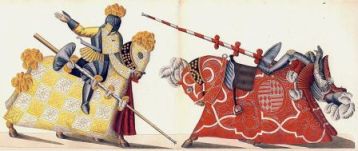
Another highly well-liked competition among knights in the Middle Ages was jousting. During a joust, two knights would charge one another while brandishing lances in an attempt to knock the other off their horse. The main attraction of numerous games and festivals was jousting. Not only did the winners receive prizes, but they were heroes.
The Ideal Knight
It was required of knights to act in particular ways. This was referred to as the Chivalric Code. An ideal knight would be well-mannered, fair, obedient, humble, and Christian.
Code of Chivalry
Here are some of the main codes which Knights tried to live by:
- To follow the church and defend it with his life
- To protect women and the weak
- To serve and defend the king
- To be generous and honest
- To never lie
- To live by honor and for glory
- To help widows and orphans
Many knights took vows that they would maintain the code. Not all knights followed the code, especially when it came to dealing with people of the lower classes.
Facts about Code of Chivalry, Jousts and Tournaments
- Sometimes a knight or group of knights would stake out a bridge and refuse to let other knights pass unless they fought. This was called “pas d’armes”.
- Tournaments and jousts attracted crowds of people for entertainment. In many ways, the knights of the Middle Ages were like the sports stars of today.
- Tournaments, jousts, and pas d’armes were all part of a number of competitions called “hastiludes”.
- Sometimes the winning knights won the losers’ horses and armor. The losers then had to buy them back. Talented knights could become rich this way.
- The word “chivalry” comes from the Old French word “chevalerie” meaning “horseman”.
- Jousting was outlawed in France when King Henry II was killed in a joust competition in 1559.
Read also: Medieval A Knight’s Coat of Arms
