 The First Encyclopedia Your First Knowledge Home
Hieroglyphics History and Facts
Learn about Hieroglyphics History and Facts, Picture writing of this world civilization.

Hieroglyphics History and Facts
Overview
Hieroglyphics, a type of image writing, were utilized by the ancient Egyptians. They first used this very ancient kind of writing around 3000 B.C. 1000s of symbols were used in the extremely complex writing system known as hieroglyphics. Like our letters, some of the symbols represented sounds, while others represented whole words.
More about Hieroglyphics
In many respects, hieroglyphics differed from the way we write today:
- It could be written almost any direction, including top to bottom and from left to right. The orientation of the symbols would let the reader determine which way to interpret it.
- They did not punctuate their sentences.
- Hieroglyphics were written with the intention of looking artistic and appealing to the eye.
- An ideogram, or single visual symbol, can represent an entire word or sound using a phonogram. A picture of an eye, for instance, might represent the word “eye” or the letter “I”.
Scribes
Hieroglyphic writing was so difficult that mastering it required years of training and practice. Scribes were those who studied how to write. They would begin training when they were just six or seven years old.
In Ancient Egypt, being a scribe was a good career. Taxes and military service were not requirements for scribes. Only the children of the wealthy had the opportunity to pursue scribe training since they were so highly esteemed.
Papyrus
In addition to writing on papyrus paper, the Ancient Egyptians also frequently used tablets and walls for their writing. Papyrus is a long, reed-like plant that was used to make papyrus paper. To manufacture the paper, the Egyptians would cut strips from the plant’s inner stem. Two layers of strips, one horizontal and the other vertical, would be created. After that, they would cover it with a linen cloth and pound it with stones or a mallet. Over time, the strips would come together to form a single flat writing surface.
Rosetta Stone
In the city of Rosetta, a French soldier discovered a unique stone in 1799. The hieroglyphic and Greek writing on this stone both conveyed the same information. This was significant since it contributed to the translation of what the hieroglyphics meant and could be applied to other hieroglyphic texts.
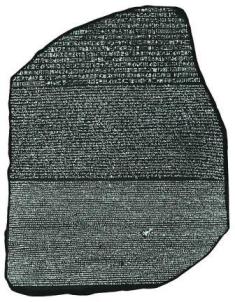
Rosetta Stone
Source: the website of the European Space Agency
Facts about Egyptian Hieroglyphics
- Sometimes scribes used a faster short form of hieroglyphics on papyrus called hieratic.
- When the Greeks took over Egypt, many scribes had to learn Greek as well.
- A very famous scribe was Imhotep. He became high priest of the sun god, designed the first pyramid, and was later turned into a god.
- Most of the Ancient Egyptians could not read or write.
Read also : Women Roles in Ancient Egypt
