 The First Encyclopedia Your First Knowledge Home
Timeline of Ancient Egypt
Learn about Timeline of Ancient Egypt in history
Timeline of Ancient Egypt
Timeline of Ancient Egypt
One of the first and oldest civilizations in history was ancient Egypt. It flourished for more than three thousand years and was situated along the Nile River in northeastern Africa. In general, historians present the history of ancient Egypt in one of two ways:
1. Dynasties:
The first method makes use of the many Egyptian dynasties. These are the families that held sway and handed down Pharaoh’s rule from one generation to the next. There were more than 30 dynasties that controlled ancient Egypt, including the Ptolemaic Dynasty that the Greeks established. This may seem like a lot at first, but keep in mind that it took place over the course of three thousand years.
2. Kingdoms and Periods:
Additionally, three main kingdoms are used by historians to categorize different eras of ancient Egypt. There is a “intermediate” period following each kingdom. The Old, Middle, and New Kingdoms were the three kingdoms.
Here is a brief summary of the kingdoms, eras, and dynasties in the ancient Egyptian civilization’s timeline:
Timeline of Ancient Egypt
Early Dynastic Period (2950 -2575 BC) – Dynasties I-III
The beginning of the civilization in ancient Egypt. Menes, the first king of Egypt, brought the cultures of Upper and Lower Egypt together. He positioned Memphis, a city, as the nation’s capital in the middle of the two lands. Hieroglyphic writing, which would be crucial for keeping records and managing the government, was invented by the Egyptians at this time.
The first pyramid is constructed by the Pharaoh Djoser and the renowned Egyptian architect Imhotep near the conclusion of the Dynastic Period and the beginning of the Old Kingdom.
Old Kingdom (2575-2150 BC) – Dynasties IV-VIII
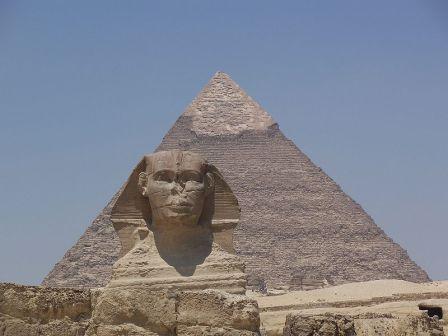
The Great Pyramids of Giza and the Sphinx are constructed as the fourth dynasty comes to an end. The Age of the Pyramids is another name for this period. In addition to being a time of peace, the fourth dynasty saw the rise of the sun deity Re as a major figure in Egyptian mythology.
The 7th and 8th dynasties are frail, and the Old Kingdom is on the verge of disintegrating. Famine and destitution are prevalent at the end of the Old Kingdom.
First Intermediate Period (2150-1975 BC) Dynasties IX-XI
Egypt divides once more into two nations. The first Intermediate era starts when the Old Kingdom comes to an end.
Middle Kingdom (1975-1640 BC) Dynasties XI-XIV
The Middle Kingdom begins when Pharaoh Mentuhotep II unifies the two regions of Egypt under his control. The royal tombs have been relocated close to Memphis in the north. To transfer water from the Nile to their crops, the Egyptians begin to employ irrigation.
Second Intermediate Period (1640-1520 BC) Dynasties XV-XVII
The Second Intermediate Period starts when the Middle Kingdom comes to an end. At the conclusion of the middle kingdom and throughout this time, certain dynasties only exist for a brief length of time. During this time, the horse and chariot are first used.
New Kingdom (1520-1075 BC) Dynasties XVIII-XX
The New Kingdom represents the apex of the ancient Egyptian civilization’s prosperity. The Egyptian Empire reaches its pinnacle during this time, when the pharaohs capture the most territories.
1520 B.C. – Amhose I reunites the kingdom and the New Kingdom begins.
1506 B.C. – Tuthmosis I becomes pharaoh. He is the first to be buried in the Valley of the Kings. For the next 500 years this will be the main burial area for the royalty of Egypt.
1479 B.C. – Hatshepsut becomes pharaoh. She is one of the most successful woman pharaohs and rules for 22 years.
1386 B.C. – Amenhotep III becomes pharaoh. Under his reign the Egyptian civilization would reach its peak in prosperity, power, and art. He builds the Temple of Luxor.
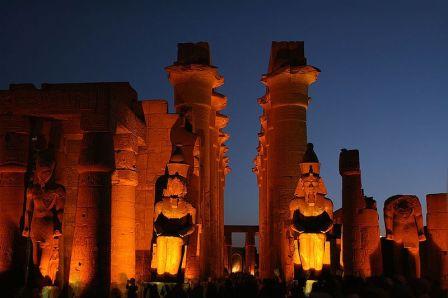
Luxor Temple. Photo by Spitfire ch
1352 B.C. – Akhenaten changed the Egyptian religion to worship a single god. This was a major change of life. It only lasted for his rule, however, as his son Tutankhamun would change the religion back to the old ways.
1279 B.C. – Rameses II becomes pharaoh. He would rule for 67 years and build many monuments.
Third Intermediate Period (1075 – 653 BC) Dynasties XXI-XXIV
Egypt’s division marks the end of the New Kingdom. Start of the third intermediate period. Near the conclusion of this time, Egypt becomes weaker and is eventually subjugated by the Assyrian Empire.
Late Period (653 – 332 BC) Dynasties XXV-XXX
When the Assyrians leave Egypt and the natives take back authority from the vassals they left behind, the late era starts.
525 B.C. – The Persians conquer Egypt and rule for over 100 years.
332 B.C. – Alexander the Great and the Greeks conquer Egypt. He founds the great city of Alexandria.
Ptolemaic dynasty
305 B.C. – Ptolemy I becomes pharaoh and the Ptolemic period begins. Alexandria becomes the new capital.
30 B.C. – The last pharaoh, Cleopatra VII, dies.
