 The First Encyclopedia Your First Knowledge Home
The Forbidden City History and facts
Learn about the facts and history of the Forbidden City in ancient China. A gigantic palace built for the Emperor in Beijing by the Ming Dynasty

What is the Forbidden City ?
During the Ming and Qing dynasties, the Chinese emperors resided in the Forbidden City. The largest historic palace in the world, it is situated in the center of Beijing, the capital of China.
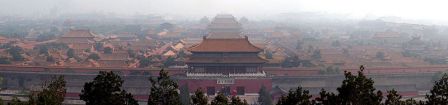 Forbidden City by Captain Olimar
The Forbidden City History and facts
When was the Forbidden City built?
Between the years 1406 and 1420, the Forbidden City was constructed on the command of the ruthless Yongle Emperor of the Ming Dynasty. The massive palace’s construction involved more than a million people. The best materials, including specially produced “golden” bricks, logs from the endangered Phoebe zhennan trees, and marble blocks, were brought in from all around China. The Yongle Emperor relocated the imperial seat of government to Beijing after the palace was finished.
How big is the Forbidden City?
Big is the Forbidden City. Over its 178 acres, there are 90 palaces with courtyards, 980 different structures, and at least 8,700 rooms. There are more than 1,600,000 square feet of floor space in all. Imagine if cleaning that floor was your responsibility. Nonetheless, the emperor had an army of attendants to look after his palace and everyone who resided there.
Features Forbidden City
The Forbidden City was also a fortress that guarded the Emperor and his household. A 170 foot wide moat and a 26 foot high wall enclose it. Guards used to keep an eye out for adversaries and assassins from the lofty guard towers that are located in each corner of the palace.
The major gate, the Meridian Gate to the south, is one on each side of the palace. The Gate of Divine Power to the north, the East Glorious Gate, and the West Glorious Gate are the other gates.
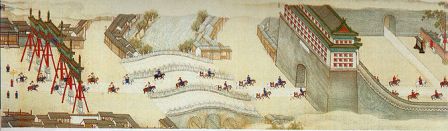
Forbidden City
Layout
The layout of the Forbidden City followed many Ancient Chinese rules of design. The main buildings all were aligned in a straight line from north to south. There are two main sections to the palace: the outer court and the inner court.
- Outer court – The southern part of the palace is called the outer court. It was here that the emperors conducted official ceremonies. There are three main buildings in the outer court including the Hall of Preserving Harmony, the Hall of Central Harmony, and the Hall of Supreme Harmony. The largest of the three is the Hall of Supreme Harmony. It was in this building that the emperors held court during the Ming dynasty.
- Inner Court – To the north is the inner court, where the emperor and his family lived. The emperor himself slept in a building called the Palace of Heavenly Purity. The Empress lived in a building called the Palace of Earthly Tranquility.
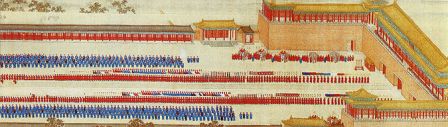
Forbidden City by Unknown
Special Symbolism
The Forbidden City was designed using Ancient Chinese symbolism and philosophy. Here are a few examples:
- The buildings all faced south which stood for holiness. They also faced away from the north which symbolized the enemies of the Chinese, cold winds, and evil.
- The roofs of the buildings in the city were made with yellow tiles. Yellow was the exclusive color of the emperor and symbolized his ultimate power.
- The ceremonial buildings are arranged in groups of three. The number three represented heaven.
- The numbers nine and five are used often because they represent the majesty of the emperor.
- The traditional five elemental colors are used throughout the design of the palace. These include white, black, red, yellow, and green.
- The roof of the library was black to symbolize water in order to protect the writings from fire.
Is it still there today?
Yes, the Forbidden City still lies at the center of Beijing city. Today it is the Palace Museum and houses thousands of artifacts and pieces of art from Ancient China.
Facts about the Forbidden City
- Twenty-four different Chinese emperors lived in the palace over the course of nearly 500 years.
- About 100,000 artisans and craftsmen worked on the palace.
- The last emperor of China, Puyi, continued to live in the Forbidden City for twelve years after he abdicated the throne in 1912.
- The Chinese name for the palace during ancient times was Zijin Cheng which means “Purple Forbidden City”. Today the palace is called “Gugong” which means “Former Palace”.
- The movie The Last Emperor was filmed inside the Forbidden City.
Read also : The Great Wall of China
