 The First Encyclopedia Your First Knowledge Home
Timeline of American Civil War
Learn about the timeline and events that took place during the American Civil war in history.
Timeline of American Civil War
The southern states and the northern states fought each other in the American Civil War. The southern states didn’t want the North dictating their behavior or passing unpopular laws. As a result, many southern states made the decision to secede and create the Confederacy, which became their own nation. The war started because the North, on the other hand, sought to keep the country undivided. The important pre-war events and the Civil War itself took place between 1860 and 1865.
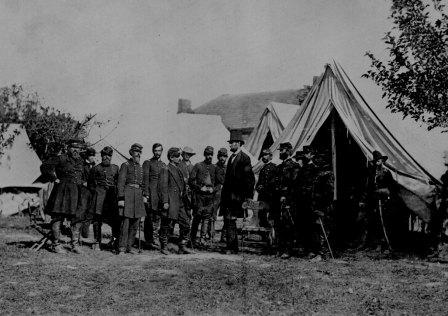
Abraham Lincoln with Soldiers
Events Before the American Civil War
Harpers Ferry Raid (October 16, 1859) : John Brown, an abolitionist, attempts to spark a rebellion by seizing control of the Harpers Ferry arsenal. John Brown is executed for treason after the revolt is swiftly put down. But he’s a hero to a lot of folks in the North.
Abraham Lincoln Elected President (November 6, 1860): Abraham Lincoln, who was from the north of the country, fought to abolish slavery. The southern states opposed him as president and opposed any laws that would have affected them.
South Carolina Secedes (Dec. 20, 1860) : The first state to secede from the United States was South Carolina. They made the decision to form their own nation rather than join the USA. Other states including Georgia, Mississippi, Texas, Florida, Alabama, and Louisiana would also quit the Union in a matter of months.
 Jefferson Davis by Matthew Brady
The Confederation is formed (Feb. 9, 1861) : The Confederate States of America, made up of the southern states, is a separate state. They have Jefferson Davis as their leader.
Abraham Lincoln becomes President (March 4, 1861) : President Lincoln wants to bring the Union back now that he is in power. Reunite the states as one nation, to put it another way.
American Civil War Timeline
The Civil War Begins (April 12, 1861) : The war is launched when the South attacks Fort Sumter in South Carolina.
More States leave the Union (April 1861) : Virginia, North Carolina, Tennessee, and Arkansas all secede from the Union and join the Confederacy within a short period of time.
Union Blockade (April 19, 1861): Abraham Lincoln declares the start of the Union Blockade, a campaign by the Union Navy to prevent supplies from reaching or leaving the Confederacy. Later in the conflict, the Confederacy will be weakened by this blockade.
Many Battles of 1861 and 1862 : Many engagements that took place in the years 1861 and 1862 resulted in numerous casualties on both sides of the conflict. The First and Second Battles of Bull Run, The Battle of Shiloh, The Battle of Antietam, and The Battle of Fredericksburg are only a few of the significant conflicts. Additionally, the Monitor and Merrimac, two ironclad battleships, engaged in a well-known naval combat. These ships had iron or steel plates for armor on their sides, making them immensely stronger and altering maritime warfare for all time.
Emancipation Proclamation (Jan. 1, 1863) : An executive order from President Lincoln frees many slaves and paves the way for the Thirteenth Amendment.
The Battle of Gettysburg (July 1, 1863) : a significant conflict when the North not only prevails but also begins to control the war.
Sherman Captures Atlanta (Sept. 2, 1864) : Georgia’s Atlanta is taken by General Sherman. He would march to the sea later that year and take control of Savannah, Georgia. He would burn and ruin a large portion of the terrain his troops traversed on the way.
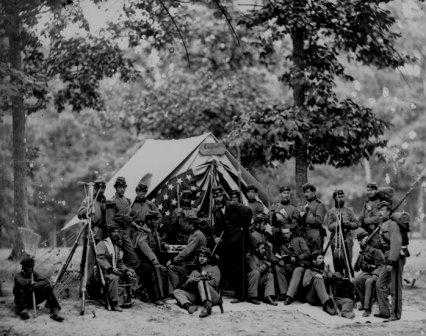
Engineers of the 8th New York State
Militia in front of a tent
from the National Archives
American Civil War Ends
General Robert E. Lee surrenders (April 9, 1865) : At The Appomattox Court House in Virginia, Confederate Army commander General Lee hands over control to General Ulysses S. Grant.
President Lincoln is Assassinated (April 14, 1865) : John Wilkes Booth shoots and kills President Lincoln while he is at the Ford’s Theatre.
Reconstruction of the South (1865-1877) : Federal forces are stationed in the South until state institutions, economy, and infrastructure are rebuilt.
Read also : History of American Revolution
