 The First Encyclopedia Your First Knowledge Home
Ancient Mesopotamia : The Empire of Persians
Learn about the history of The Empire of Persians Also known as the Achaemenid Empire, they ruled the Middle East before the Greeks arrived
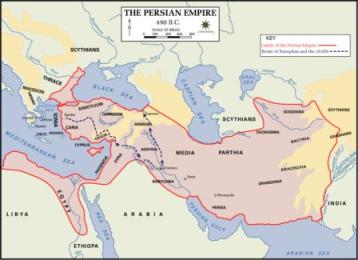
The Empire of Persians
After the demise of the Babylonian Empire, the first Persian Empire ruled the Middle East. The empire is also known by the name Achaemenid.
Cyrus the Great
Cyrus the Great laid the foundation for the empire. In 550 BC, Cyrus initially overthrew the Median Empire before going on to subjugate the Lydians and the Babylonians. Later monarchs would expand the empire until it controlled Mesopotamia, Egypt, Palastine, and Turkey. It would eventually become the biggest empire on Earth, with borders extending more than 3,000 kilometers from east to west.
Difference of cultures
The Persians enabled the conquered peoples to maintain their ways of life and traditions under Cyrus the Great. As long as they paid their taxes and submitted to the Persian emperors, they were allowed to maintain their traditions and faith. This contrasted with prior conquerors like the Assyrians who had exercised power.
Formation of the government
Each region had a ruler known as a satrap in order to retain control of the vast empire. The satrap served as a local governor. He carried out the king’s taxes and laws. The empire had between 20 and 30 satraps.
A postal system and numerous highways united the empire. The Royal Route, constructed by King Darius the Great, is the most well-known road. The distance of this road from Sardis in Turkey to Suza in Elam was almost 1,700 kilometers.
Religion of Empire
Even while each civilization was free to practice their own religion, the Persians adhered to Zoroastrianism. This religion, known as Zoroastrianism, had a single supreme deity named Ahura Mazda.
War with the Greeks
The Persians under King Darius sought to subjugate the Greeks because he believed they were instigating uprisings within his dominion. Darius attacked Greece in 490 BC. He conquered a few Greek city-states, but the Athenians soundly defeated him at the Battle of Marathon when he tried to attack the capital city of Athens.
In 480 BC, Xerxes I, the son of Darius, made an effort to complete his father’s conquest of Greece. He gathered a vast army of soldiers numbering in the hundreds of thousands. One of the biggest armies ever gathered in antiquity was this one. He first triumphed in Thermopylae over a Spartan force that was considerably smaller. However, at the Battle of Salamis, the Greek fleet routed his naval, forcing him to retire.
The end of the Persian Empire
The Greeks under Alexander the Great subdued the Persian Empire. Alexander the Great swept the Persian Empire from Egypt all the way to the boundaries of India beginning in the year 334 BC.
Facts About the Persian Empire
- The term “Persian” is derived from the original tribal name of the population, Parsua. This was also the name they gave the region where they first made their home, which was bordered by the Persian Gulf to the south and the Tigris River to the west.
- Artaxerxes II, who governed the Persian Empire for 45 years between 404 and 358 BC, had the longest reign. The empire enjoyed peace and prosperity under his rule.
- The truth was highly valued in Persian society. One of the most shameful things a person could do was to tell a falsehood.
- The magnificent metropolis of Persepolis served as the empire’s capital. Greek for “Persian City,” this name.
- The Jewish people were given permission to return to Palestine and construct their temple in Jerusalem after Cyrus the Great overthrew Babylon.
The Empire of Persians.
Read also : The Empire of Assyrian
