 The First Encyclopedia Your First Knowledge Home
Biography of Louis Pasteur : Discovered pasteurization, vaccines, and founded the science of germ theory.
Learn about Louis Pasteur biography. He was a scientist who studied microorganisms like bacteria. He discovered pasteurization, vaccines, and proved that germs cause disease
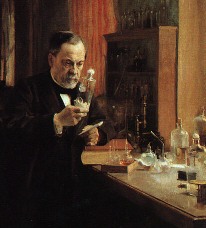
Who is Louis Pasteur ?
Louis Pasteur biography
- Occupation: microbiologist and Chemist
- Born: in France , December 27, 1822
- Died: in laFrance , September 28, 1895
- Best known for: pasteurization, the development of immunizations, and the demonstration of the pathogenicity of bacteria.
Biography of Louis Pasteur
Early Life
On December 27, 1822, Louis Pasteur was born in Dole, France. He came from a low-income home and was a typical student in his early years who loved music and art. However, Louis realized he had found his vocation when he first encountered science as a teenager.
College and Career
In 1838, Louis went to college to become a science teacher. He earned degrees in mathematics, physics, and chemistry. He then became a chemistry professor at the University of Strasbourg.
Scientific Discoveries
Bacteria and Germ Theory
During Pasteur’s time, people believed that microbes such as bacteria appeared due to “spontaneous generation.” They thought that the bacteria just appeared out of nowhere. Pasteur ran experiments to see if this was true. Through his experiments he proved that germs (i.e. bacteria) were living things that came from other living things. They didn’t just spontaneously appear. This was a major discovery in the study of biology and earned Pasteur the nickname the “Father of Germ Theory.”
Pasteurization
Pasteur used his knowledge of germs to investigate how beverages such as wine and milk were spoiled by microbes such as bacteria and molds. He found that heating up the liquids would kill most of the microbes and allow the beverages to last longer and be safer to drink. This process became known as pasteurization and is still done on many foods such as milk, vinegar, wines, cheese, and juices.
Silk Worms
As Pasteur learned more and more about bacteria, he began to think they may be the cause of disease in humans. When the French silk market was threatened by a disease to silkworms, Pasteur decided to investigate. He discovered that this disease was caused by microbes. By eliminating the microbes from the silkworm farms, he was able to end the disease and save the French silk business.
Vaccinations
Pasteur continued to investigate with diseases. He found that he could make a weak form of a disease that would cause people to become immune to the stronger form of the disease. Pasteur called this weak form a “vaccine.” He first discovered this by working with cattle on the disease anthrax. The first vaccine he gave to a human was the rabies vaccine. He administered it to a nine year old boy name Joseph Meister in 1885
Legacy
Today Louis Pasteur is known as one of the most important scientists in history. His discoveries led to an understanding of microbes and diseases that has helped to save millions and millions of lives.
Pasteur is most remembered by the Pasteur Institute which he established in 1887. Today the Pasteur Institute is one of the world leaders in battling infectious diseases.
Louis Pasteur died in 1895 from a stroke. He was buried in the Cathedral of Notre Dame in Paris, France.
Facts about Louis Pasteur
- Early on in his career Pasteur studied crystals and discovered why some crystals bend light while others do not.
- He was a deeply religious Christian throughout his life.
- Pasteur’s ideas on micro-organisms causing disease eventually led to the boiling of surgical instruments helping to prevent infections and causing many people to survive surgery.
- He once said that “In the field of observation, chance favors the prepared mind
Louis Pasteur biography.
Read also : Isaac Newton biography
